

The Milan Urban Food Policy Pact:
North and Central America Regional Forum builds municipal momentum for food systems collaboration
by Patricia Ballamingie, Moe Garahan & Alison Blay-Palmer
July 14, 2026
The Milan Urban Food Policy Pact (Milan Pact), launched at Expo Milano 2015, is a voluntary international agreement among cities around the world dedicated to “developing sustainable food systems that are inclusive, resilient, safe, and diverse.”
Currently, 330 signatory cities have signed on to advance the equity, sustainability and resilience of their urban food systems [including six Canadian cities: Vancouver (2015), Toronto (2015), Montreal (2017), Guelph (2021), Halifax (2023), and Vaughan (2025)].
This global pact signals a municipal commitment and connects municipalities around the world through its online platform to share good practices and inspire municipal leaders and civil society actors to build capacity and further advance their local food systems.
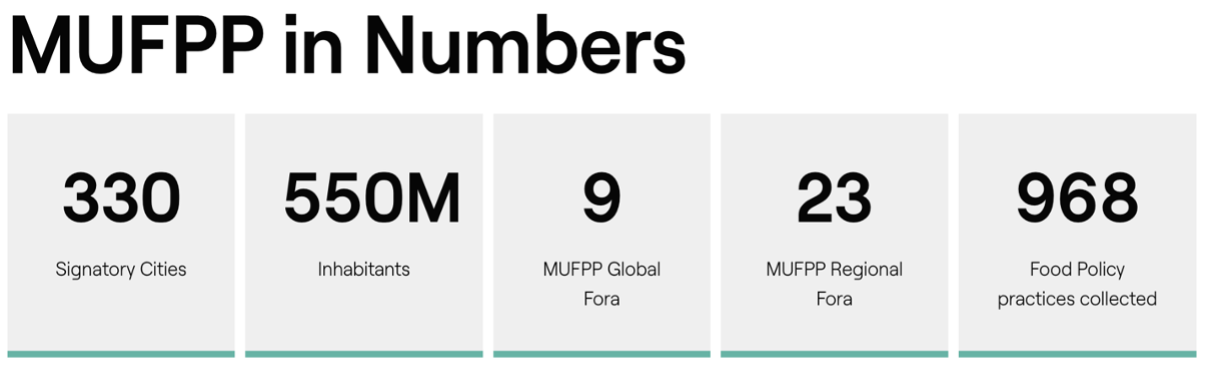
The Milan Pact dashboard gives a snapshot of participation and impact
The Milan Pact embodies the adoption of an
integrated and holistic approach to food systems
thinking.
The Milan Pact’s Framework
for Action includes Six Pillars
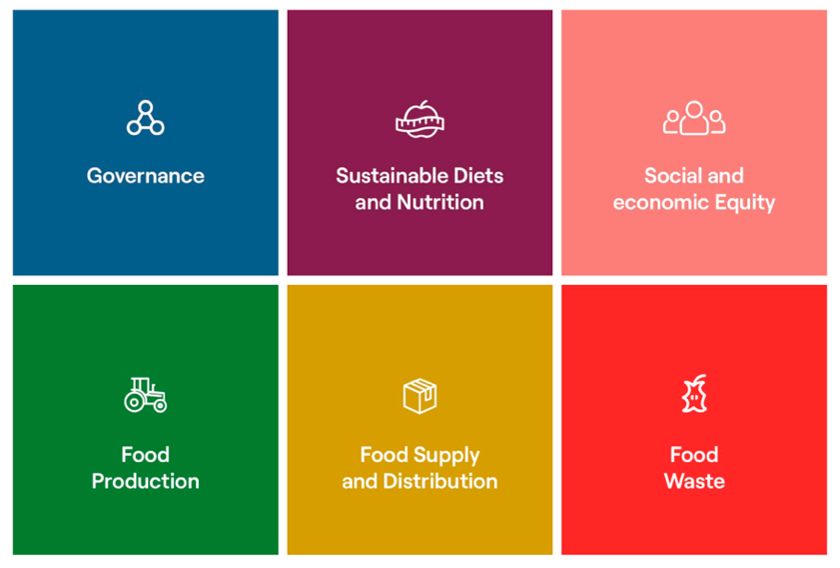
Each pillar has a specific set of actions attached to it, along with associated indicators to measure progress over time. For example, the Governance pillar aims to enhance participation and collaboration across city agencies and departments, involve a broad range of stakeholders in food policy and planning, create inventories of local food initiatives and practices, develop or update food policy strategies, enhance multisectoral information systems, and develop disaster risk mitigation strategies.
The annual Milan Pact Awards recognize outstanding achievement across a range of sustainable food system categories – selected to demonstrate initiatives across scale, embrace a diversity of practices, and reflect broad regional representation. Canadian recipients include: Vancouver (2022) for its Vancouver Plan for food systems through to 2050; and Guelph (2022) for its food rescue and waste diversion.
First-ever North and Central America Regional Forum
From March 10 to 11, 2026, the first-ever North and Central America Regional Forum was held in Austin, Texas. Municipal leaders, food policy advocates, and practitioners shared innovative practices and strategies for effecting change. Building upon the 2025 MUFPP Global Forum final declaration, participants have continued to work into the summer to develop the regional roadmap for work over the next couple of years to: establish a self-sustaining, cross-nation network of 50+ cities; build collective momentum through collaboration towards sustainable, resilient, and equitable food systems; scale national school meal programs; and work towards the next regional forum in 2028. These ends will be advanced through strategic operational leadership of a Regional Coordinated Team, knowledge sharing and data-driven regional exchange, coordinated messaging to support advocacy, and collaborative fundraising. Food Communities Network will facilitate the inclusion of Canadian cities in this work.
Why is participation in the Milan Pact so timely?
In Canada, household food insecurity has reached record levels, affecting 1 in 4 individuals, with children comprising 1 in 3 food bank clients, according to Food Banks Canada. Factors driving this food insecurity include inadequate income and inequitable access to land and water for food production at a household and community levels with disproportionate impacts on Indigenous peoples. Moving from the local to the global scale, Kerr et al. (2025, March 17) argue that geopolitical tensions (from tariff threats to war) and the resulting precarity of global supply chains demand urgent policy change to foster more resilient local food systems with better infrastructure and increased supply near the top of the list. The authors further identify supply-side barriers for smaller-scale producers. Foster et al. (2025, March 18) even argue that national defence must be broadened beyond military strength and civilian preparedness to include the strength and resilience of our food system.
The Milan Pact provides much-needed broad policy scaffolding within which more localized efforts can be situated to address these wide-ranging influences. The Pact approach responds to Foster et al.’s call to “crisis-proof” Canada’s food systems, starting at the municipal level. It foregrounds food systems thinking in urban planning, rather than continuing to have it serve as an afterthought in policymaking. This in turn can serve as a lever for food systems change, spurring cities to make more meaningful progress, encouraging municipal governments to adopt a city-region food systems lens, and galvanizing local action.
The best policies articulate across scale (from the local through to provincial, federal, and international and back). The Milan Pact connects local structures grounded in practice across diverse contexts (economic, social, political, geographical) to a global community of practice.
The Food Learning and Growing (FLOW) Partnership (Blay-Palmer et al. 2026) has identified city-region food strategy work as a core capacity critical to food systems change, and supports Just Food/Alimentation juste in Ottawa and the Montréal Food System Council – Le Conseil du Système alimentaire de Montréal in their ongoing food strategy leadership. These actors have a critical leadership role to play in developing strategies and indicators, given their expertise and embeddedness within the community. Moreover, Food Communities Network – Réseau Communauté Nourricières (FCN-RCN) has compiled a Food Strategy Toolkit to support communities coast-to-coast-to-coast (see p. 55 to access a breakdown of food policies by category as of 2021, with an update underway, coming out in 2027).
The Milan Pact serves as a strong signal of municipal commitment
Municipalities have a critical role to play in building just and sustainable food systems, with the Milan Pact being one key framework for inspiration, often integrated with other frameworks, including: Indigenous Food Sovereignty, the City Region Food Systems Program of the Food and Agriculture Organization of the United Nations, and C40 Cities, among others.
Beyond the six signatory cities to the Pact, there are notable absences, with efforts underway in many other cities by civil society actors to call for their city to join.
So, Canadian cities, who’s next to sign the Milan Pact?
Patricia Ballamingie is a Professor in the Department of Geography and Environmental Studies/Institute of Political Economy at Carleton University in Ottawa, ON, Canada.
Moe Garahan is the Partnership Coordinator of Food Communities Network – Réseau Communauté Nourricières (FCN-RCN), hosted by Just Food, and Community Co-Lead of the Ottawa Region for the FLOW Partnership.
Alison Blay-Palmer is a Professor and UNESCO Chair on Food, Biodiversity and Sustainability Studies at Wilfrid Laurier University in Waterloo, ON, Canada.
Disclosure Statement: This research, the Food Learning and Growing (FLOW) Partnership, has been funded by the Social Sciences and Humanities Research Council of Canada as a Partnership Grant, led by Dr. Alison Blay-Palmer, with Patricia Ballamingie as a Co-Investigator, and Moe Garahan as a Community Partner.

