
2026 Fall Farm Fest

Enjoy Tons of FREE Activities:
Vendors
Information Booths
Workshop Schedule:
Getting to the Farm
The Just Food Community Farm is located at 2391 Pepin Court in Blackburn Hamlet, Ottawa.
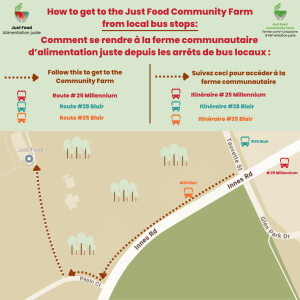
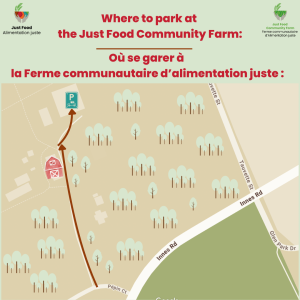
We offer free parking onsite. You can also get to the farm by public transit: bus route #25/ LRT: Blair , or by bike.
Click here for more information on directions.
Accessibility info:
We have an accessible lift and washroom in the Big Red Barn
Our pavilion, where most vendors are located, is paved, and will have a rubberized pathway from the parking lot for access
Our roads are compacted gravel with mixed terrain and sloping
We will have staff and volunteers on site that will be available for support
Music will be playing throughout the day, one generator may be running, please notify a member of staff or a volunteer if you are in need of locating a quiet space
We have 2 portapotties on site (in addition to accessible washroom in barn)
Workshops will be held in the Big Red Barn, which is accessed either via a set of stairs leading up one flight, or via an accessible lift.
If you have any questions on accessibility, please contact director@justfood.ca



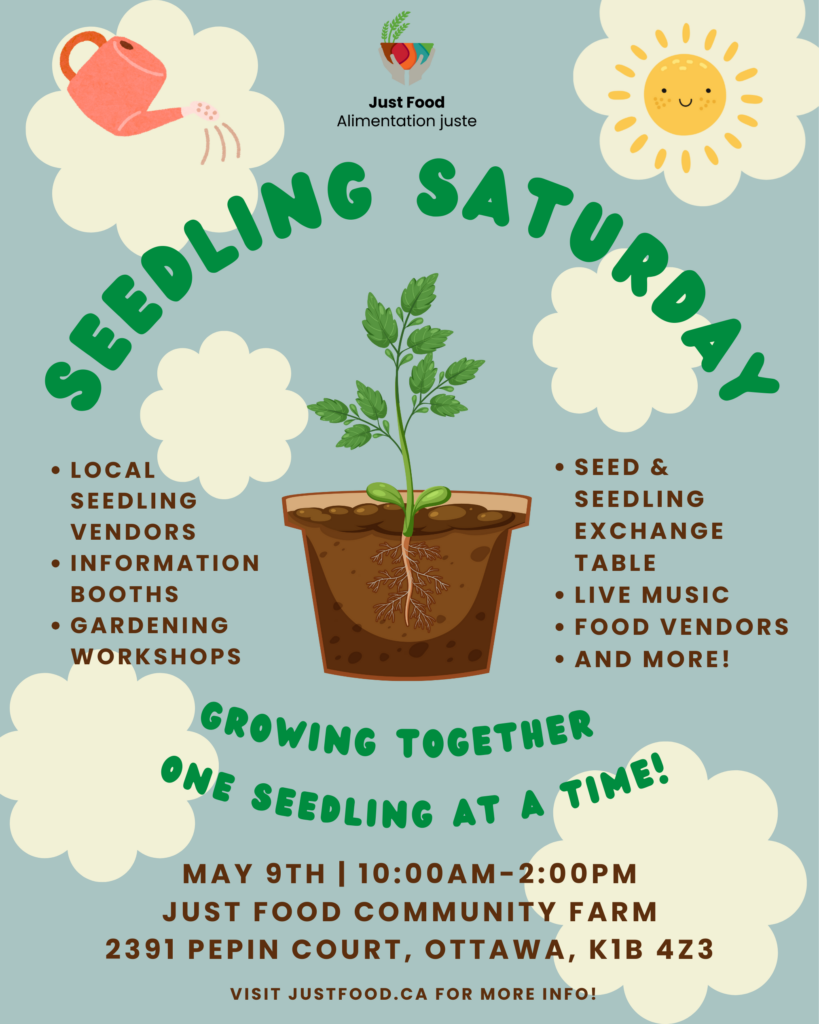
Save the Date: SeedLing Saturday 2026 is coming May 9th!
SeedLing Saturday is our much-loved annual event, held before the long weekend each May, where farmers, gardeners, and community members gather to celebrate the joys of spring and kick off the growing season together! This event is the perfect opportunity to pickup local seeds and seedlings to get in the ground at the end of May.
This year’s SeedLing Saturday will be held:
May 9th, 2026
10:00AM – 2:00PM
at the Just Food Community Farm
(2391 Pepin Court, Ottawa, K1B 4Z3)
Free parking available on site, accessible by Bus Route #25.
Are you interested in being a vendor?
Fill out this form
Farmers, home growers, all are welcome! You must be able to declare that your seedlings are grown using ecological practices, grown from non-GMO and untreated seed, and are not invasive/noxious species.
Genetically Engineered (GE) Seeds – The Purple Tomato and what you need to know
Home gardeners and small-scale growers in Canada may soon see geneticallyengineered vegetable seeds on the market, and many farmers are raising serious concerns.
Over 150 organic and local market growers from Ontario and British Columbia signed a declaration opposing the sale of GE seeds to gardeners, warning that these products could contaminate heritage seeds, undermine seed-saving traditions, and threaten organic farming. Organic standards prohibit GE seed, and critics say the government’s current labeling and regulatory approach lacks transparency.
One example is the recently approved genetically engineered “Purple Tomato”, whose seeds are already being sold online to growers in Canada and the U.S. Other new GE and gene-edited vegetables could soon follow. Farmers and advocacy groups are calling for clear labeling and stronger seed sovereignty protections.
Learn more at the Canadian Biotechnology Action Network’s:https://cban.ca/farmers-warn-home-gardeners-about-genetically-engineered-vegetable-seeds-coming-soon/
And click here to learn ways you can take action:
https://cban.ca/take-action/protect-our-seeds/
Community Gardening on City-land: Applications now open
PLUS How to Start a Community Garden workshop, Jan 21st
As many of you will have been following across the years, the City of Ottawa has been working on updating their policies for community gardening on City lands.
Just Food has worked closely with the new City staff team to transition information from the many years of continued partnership in bringing forward new community gardening initiatives on City land.
The City of Ottawa is now accepting applications (until February 3 2026) for new community gardens, or upgrades and expansions to existing gardens, located on City land.
If your community garden is on City land, or you’re exploring a new gardening project on City land, this is an important opportunity to access approvals to move your project forward.
The Community Gardening Network will continue to be here to provide support as you navigate the application process; we welcome you to contact us at info@justfood.ca as needed.
Click here for more information
on applying to access City land for your community gardening project.
The City is also hosting an information session next week:
January 14, 6:30–8 pm (Nepean Sportsplex, Hall A)
Please note: all long-standing requests have been reviewed through an internal City process separate to this new application. This application process is for new and/or updated requests.
The Community Gardening Network is here to support you!
Community groups are encouraged to reach out to us for support with planning and next steps, or to walk through the application process together if interested in accessing City land.
We are also of course here to provide support for ALL new and existing gardening initiatives on any lands, including NCC, school, private, faith group lands, etc).
Eligible gardening projects on any lands can also apply for funding through the Community Garden Development Fund, which supports community gardening initiatives across Ottawa.
Click here to read more about the Community Garden Development Fund.
If you have any questions, or would like feedback/support on a specific project, please contact us at info@justfood.ca.
To learn more about starting a community gardening project, including an overview of the supports the CGN provides (i.e. free bank account, access to insurance, and much more!) we invite you to our upcoming workshop:
How to Start A Community Garden Workshop
Wednesday, January 21st, at 6:30pm
via Zoom
Click here to register
About the workshop:
Join us to learn about the steps you need to take to start a community gardenin the Ottawa region. Learn everything you need to know to make your community garden a reality, including:
- How to search for land
- How to access City and NCC land
- Information on garden design, building, leadership, & communityoutreach
- How to apply for funding through the Community GardeningDevelopment Fund (CGDF)
- Important tips for long-term success!
Suitable for new gardens, or existing gardens looking to onboard new volunteer coordinators.
No experience required – simply your passion for local and organic food security!
Please share with your fellow gardeners.
Thank you all for your continued commitment to community gardening!
New Emergency Food Security Fund direction Passes at City Council
Just Food’s request for adequate funding is responded to:
Today, a staff direction introduced by Councillor Rawlson King has been passed at City Council directing staff to explore the creation of a dedicated emergency food security fund.
Staff will review the Office of Emergency Management’s framework and present options for establishing a rapid-response funding stream, potentially up to $1 million, to support residents facing food loss during extreme events. The City will consult community food organizations, food banks, and emergency response partners to design an equitable, fast-delivery model prioritizing high-needs neighbourhoods.
Recommendations and financial options will return to Council ahead of the 2027 budget.
This is a critical step in ensuring community agencies can confidently commit to their role in the City’s Emergency Food Security Response Plan, ultimately leading to a more resilient Ottawa.
Just Food’s Ask:
This follows Just Food’s delegation at the committee-level Nov 20th (read more about it here) to address this.
The expectation to date has been that community organizations would respond in the case of a one-time emergency, using their own reserves to pay for overtime, transportation, food costs, utilities, etc. This is a significant barrier for participation from these community organizations that are already stretched thin, with increasing, unrelenting demand already for daily food access programs.
Just Food – a member of the City’s Emergency Food Security Response Task Force – delegated on the need for an Emergency Food Security Response Fund.
The Task Force consists of community organizations that would be engaged to act in the case of one time food emergencies.
You can watch Councillor King’s direction to staff here:
Delegation to Emergency Preparedness Committee
On Thursday, November 20th, Just Food delegated to the Emergency Preparedness and Protective Services Committee in relation to the need for the City of Ottawa to fund the City’s Emergency Food Security Response Plan.
We invite you to watch the delegation, or read the transcript below.
My name is Kate Veinot and I am here on behalf of Just Food, which is a member of the Emergency Food Security Task Force. We appreciate the work that this Committee and City staff are doing to strengthen Ottawa’s emergency preparedness in a time of growing climate instability, increased extreme weather events, growing socio-economic unrest and rising household food insecurity.
Today, I want to speak to a single, urgent point: the 2026 Draft Budget must include dedicated funding to support the food security sector’s role in the City’s food security emergency response plan.
The City’s Emergency Food Security Plan, still in the process of being vetted, relies on a network of community organizations such as food banks, community kitchens, neighbourhood-serving groups, and distribution hubs, to activate during a crisis. These are the organizations expected to keep residents fed when basic systems are disrupted.
But right now, the expectation that non-profits and charities can simply “step in” during an emergency without committed resources to do so is not realistic, not responsible, and not in line with how the City funds other essential emergency functions.
These organizations are already operating far beyond their capacity to deal as social services providing to those dealing with hunger on a daily basis in our city.
We are all managing unprecedented demand due to inflation, high housing costs, and funding levels that are just keeping their heads above water.
We are all relying on overburdened staff and volunteer networks who are already doing everything they can just to maintain daily operations.
To ask our organizations to take on additional emergency responsibilities without any designated funding for staff time, coordination, utilities, food purchasing, equipment, or transportation is to set up the system for failure at the very moment residents need it to succeed.
Let me be clear:
Non-profit organizations want to help during emergencies.
We are committed to the wellbeing of our communities.
But we cannot be expected to absorb unfunded emergency obligations on top of existing workload.
When we talk about emergency preparedness, we talk about reliability.
We talk about predictable systems that activate when needed.
In an emergency… We fund fire services. We fund paramedics. We fund public works. We fund police.
Because we understand that emergency response cannot depend on goodwill alone.
Food access during one-time crises is no different.
It is a core component of public safety and emergency preparedness.
And it must be funded as such.
If the City intends for community organizations dealing with information, housing connections, seniors, and food provisioning to be partners in emergency food response, then the City must budget accordingly so these organizations know that when we commit to being part of the plan, we do so with the confidence that it is funded, coordinated, and taken seriously.
Right now, that is not the case.
The 2026 Draft Budget presents an opportunity to correct this.
We are asking this Committee to:
Include a dedicated budget line for emergency food security response;
Fund staffing, infrastructure, coordination, and food procurement costs required for organizations to activate safely and effectively in an emergency; and
Work with community partners in 2026 to finalize a transparent funding model so that commitments are clear well before the next emergency occurs.
Ottawa’s emergency food response system will only be as strong as the resources we put into it.
Right now, the system is running on hope, volunteerism, and exhausted staff.
That is not a plan. And it is not fair to the organizations your emergency plan depends on.
We urge you to ensure that the 2026 Budget recognizes emergency food response as the essential City function that it is… and to fund it at the level required to keep our residents safe, fed, and supported in the moments that matter most.
Thank you for your time, and for your commitment to building a more resilient Ottawa.

